Hands-Free Workflows on Android: Offline Speech Recognition and Hybrid LLMs in Practice
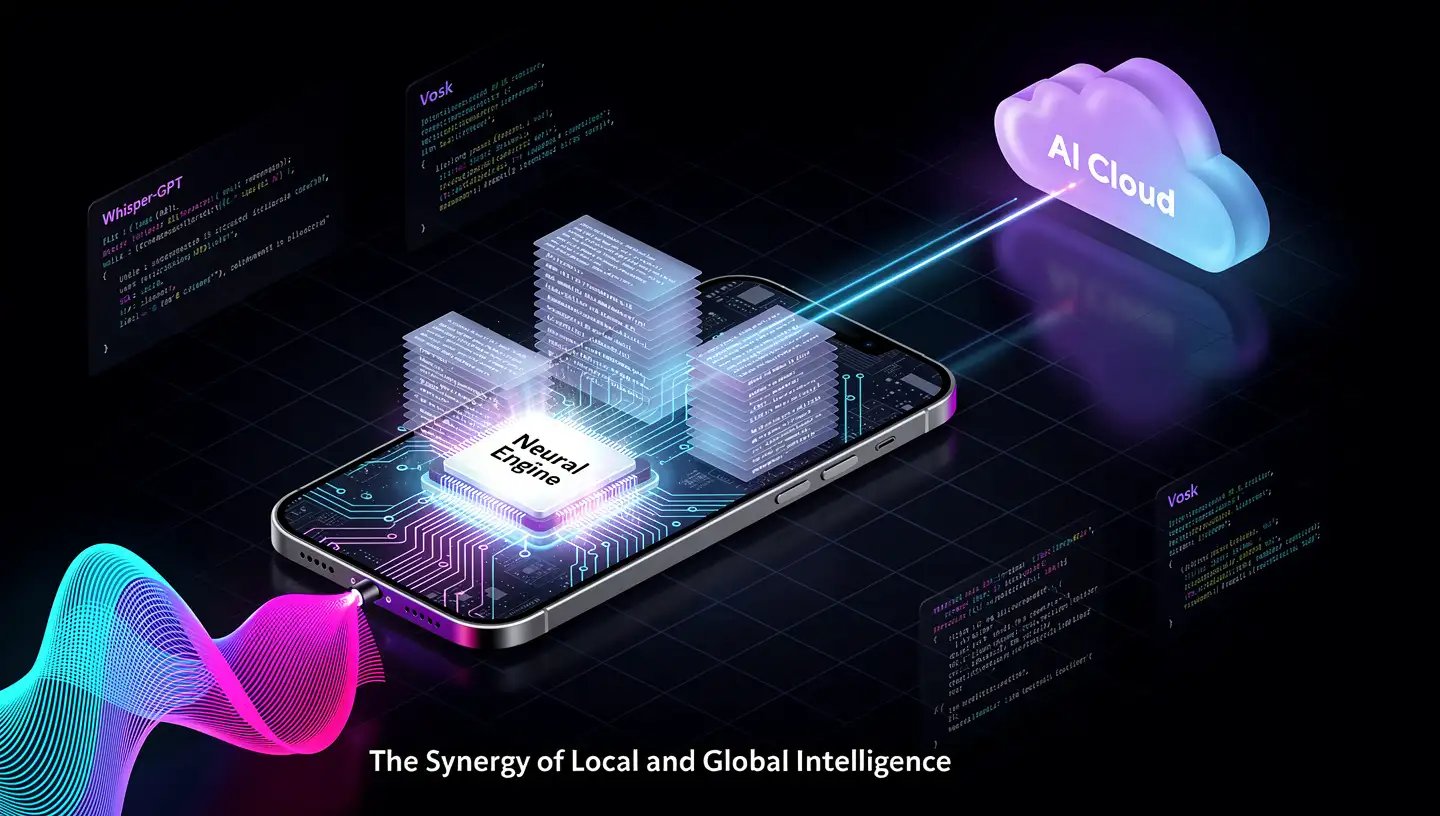
Dictating code while walking, drafting an article on a crowded train, or logging inspection notes without stopping work is no longer unusual. On Android devices, offline speech recognition combined with hybrid large language models now makes this routine. As of January 2026, these tools are widely used by developers, writers, and field workers who cannot rely on steady connectivity.
Speech recognition has improved sharply. OpenAI’s Whisper reports word error rates as low as 2.46 percent in benchmark tests. Dictation tools can push writing speed to about 125 words per minute, roughly three times faster than typing for many users. The commercial momentum reflects this. The voice recognition segment was valued at USD 7.39 billion in 2023 and is projected to account for 27 percent of the global speech technology market by 2025, driven by healthcare, mobile work, and IoT deployments.
What has changed is not only accuracy, but where the processing happens. More speech is handled directly on the device, with cloud systems used selectively. That shift underpins most hands-free workflows on Android today.
How offline speech recognition works on Android
Offline speech recognition is now a core part of the Android stack. Google’s Speech-to-Text system handles voice commands and transcription across built-in apps, including Recorder, Google Maps voice search, and the Phone app’s Call Screen feature. Users can set it as the default recognition service through the system settings. Accessibility tools such as Voice Access rely on the same engine to provide full device control by voice, particularly for users with limited mobility.
Beyond Google’s services, several offline and open-source engines are in active use. As of April 2024, Vosk supports nine languages on Android and offers compact models of about 50 MB for more than 20 languages and dialects. Mozilla’s DeepSpeech also runs fully offline and is commonly embedded into custom Android apps. Consumer-facing tools such as Dicio Assistant and FUTO Keyboard provide offline voice input; FUTO is often cited for higher accuracy than default keyboards.
Under the hood, many mobile systems still rely on Hidden Markov Models combined with deep neural networks. On-device models tend to have smaller vocabularies and are optimized for short commands or dictation with low latency. When a task exceeds those limits, Android apps often fall back to cloud processing for broader language support. The SpeechRecognizer API handles permissions, audio capture, and noise suppression, reducing the work required to integrate voice features.
Some alternatives come from outside the Android ecosystem. Microsoft SAPI allows offline speech recognition without a network connection, while the Windows.Media.Speech.Recognition engine supports grammar-based offline tasks, though not full dictation. At the hardware level, modules such as the Gravity Offline Speech Recognition Module ship with 121 built-in commands and 17 customizable ones. They provide real-time feedback over I2C or UART and are commonly used with Arduino or ESP32 boards for education and field projects.
This foundation supports more advanced systems that add language understanding on top of raw transcription.
Local and hybrid LLMs add context
Hybrid language models split work between the device and the cloud. As of September 2025, local speech-to-text and text-to-speech paired with lightweight LLMs can run on standard hardware using two CPU cores and a few gigabytes of RAM. That setup is enough for scripted interactions and basic reasoning without specialized chips.
In practice, many systems use on-device wake-word detection and speech recognition for simple commands, while sending small text payloads to the cloud for more complex tasks. This design reduces bandwidth use and operating costs and works in environments with poor connectivity.
Whisper-GPT is one example of this hybrid approach. It combines continuous audio input with discrete token modeling and reports better perplexity scores than earlier speech-and-music models. Microsoft’s Azure Speech platform incorporates similar ideas, using Whisper-based transcription and supporting offline speech-to-text and text-to-speech when connectivity is intermittent. This makes it suitable for Android deployments that cannot assume constant network access.
On the output side, tools such as Piper and Sherpa provide local neural text-to-speech engines on Android. Users can install them via APKs and set them as default voices, keeping audio output fully offline.
These building blocks are now used in concrete workflows, particularly in software development.
Hands-free coding in practice
Voice-driven coding on Android is no longer limited to simple dictation. Talon Voice is widely used for hands-free software development, mapping spoken commands directly to programming syntax and editor actions. Users can define custom phonetic shortcuts, navigate code, and apply naming conventions by voice. Saying “snake hello world” produces hello_world; “camel hello world” produces helloWorld.
Braden Wong’s workflow combines Whispering for real-time transcription with Claude Code agents. His setup runs three to six agents in parallel and costs about USD 0.02 per hour in API usage. Voice activation allows continuous interaction while walking or doing household tasks, with a clip-on microphone capturing ideas as they occur. Whisper’s training on roughly 680,000 hours of audio since 2022 helps it handle accents and technical vocabulary common in programming.
For developers building their own tools, Vosk’s Java bindings allow custom command systems inside Android editors. The Gravity module’s configurable commands are sometimes used for project-specific triggers or educational coding environments.
Similar techniques are now common in writing and editing.
Writing by voice, without the cloud
Writers use offline dictation to capture text without breaking concentration. Wispr Flow supports hands-free dictation across platforms, including team and field settings. Monologue applies context-aware models to improve recognition for longer-form writing. Tools such as Otter.ai and Zoom transcription are often used to capture brainstorming sessions, though they typically rely on connectivity.
Once text is captured, LLMs such as ChatGPT or Claude are used to generate outlines or revise drafts for grammar and clarity. Whispering supports voice-driven drafting of emails or social posts. FUTO Keyboard improves offline input accuracy for longer passages. Piper’s local text-to-speech lets writers listen to drafts for review without sending text off-device. Eleven Labs’ Reader app is used for hands-free audio playback, often as reference material rather than dictation.
The same offline-first approach is critical outside office environments.
Field work and offline documentation
For inspectors, caregivers, and other field workers, offline speech recognition enables real-time documentation in remote areas. The V2M app converts speech from deaf-mute users into recognizable output. In pilot studies involving 15 children aged 7 to 13, it achieved 97.9 percent accuracy.
In healthcare, SpeakHealth tested a voice note–taking app with 41 caregivers. Eighty percent agreed it improved task performance. The app generated 88 voice notes, most under 20 seconds long, and more than half of participants changed their preferences for symptom tracking. Adoption was eased by the fact that 68.3 percent already used mobile health apps.
Speech input also reduces documentation errors. One study found offline speech recognition produced an average of 4.56 spelling errors per nursing report, which dropped by 97.20 percent after correction. This compared favorably with handwritten notes and reduced data loss. Clinicians increasingly dictate directly into electronic health records, especially in mobile settings.
Hardware modules like Gravity, with onboard microphones and speakers, are used in outdoor projects and classrooms. DeepSpeech is often embedded into custom field apps that must operate without connectivity. Wispr Flow is also used by mobile teams for hands-free note capture.
Limits, improvements, and market direction
Accuracy is still not perfect. Online speech recognition averaged 6.76 errors per nursing report in one comparison, though corrections reduced errors by 94.75 percent. On-device systems remain constrained by vocabulary size and model capacity, which is why hybrid designs persist.
Technical progress continues. Far-field recognition and synthesis improvements reported in 2024 have made voice interfaces more responsive in noisy environments. Voice-enabled IoT systems are expanding, often combining touch and speech rather than replacing one with the other.
Hardware has played a role. Apple’s A14 Bionic Neural Engine, introduced in 2020, delivers 11 trillion operations per second. Google’s Pixel Neural Core, introduced in 2019, similarly accelerated on-device inference. These gains support the market forecast that voice recognition will reach 27 percent share by 2025, alongside accessibility-focused applications such as V2M.
Conclusion
Offline speech recognition and hybrid language models have become practical tools on Android, not experimental features. Vosk’s compact models, Whisper’s accuracy, and hybrid systems such as Whisper-GPT show how much processing can now happen locally, with cloud services used sparingly. For developers, writers, and field workers, this reduces dependence on connectivity and allows work to continue in motion.
The technology still has limits, but its direction is clear. As hardware improves and hybrid designs mature, voice-driven workflows are becoming a standard option for mobile work rather than a niche accommodation.