How On-Device AI Is Reshaping Learning and Student Privacy
Introduction: AI’s growing role in education
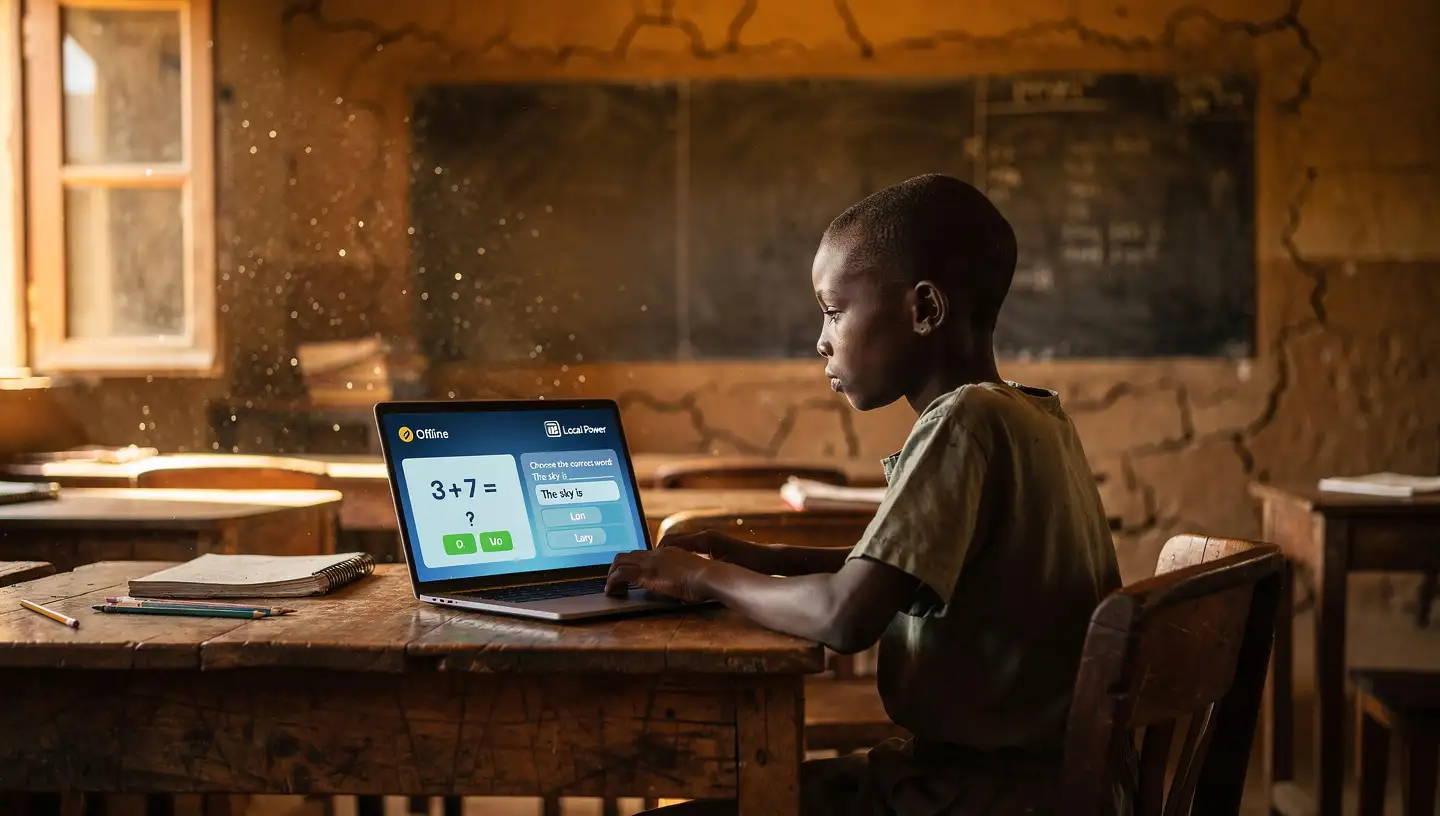
In a remote village in Guatemala, students practice Spanish and work through math problems with an AI tutor that runs entirely offline. There is no cloud connection and no steady internet. The system lives on the device in front of them. This setup is already in use, not a pilot or a concept demo.
AI use in education has expanded quickly. According to Stanford’s 2025 AI Index Report, two-thirds of countries now offer or plan to offer K–12 computer science education, up from one-third in 2019. Africa and Latin America show the fastest growth. In the United States, the number of graduates earning bachelor’s degrees in computing has risen 22 percent over the past decade.
Student use of AI tools is now common. Global surveys report that 86 percent of students in secondary and higher education use some form of AI. At the university level, that figure rises to 92 percent. About 66 percent of students say they use ChatGPT specifically for schoolwork.
Some outcomes are measurable. After adopting Microsoft 365 Copilot Chat, students reported a 265 percent increase in self-directed learning and a 15 percent increase in pass rates. Students also described higher engagement and confidence.
As adoption grows, so do concerns about cost, connectivity, and data privacy. Most education AI systems depend on cloud services that require constant internet access and transmit student data to external servers. Local AI takes a different approach.
What on-device AI does differently
It runs models directly on local hardware such as laptops, tablets, or smartphones. Data is processed on the device rather than sent to a remote data center. This allows real-time responses without relying on a network connection.
Because data does not leave the device, on-device AI reduces exposure during transmission, which is a common source of data breaches in cloud systems. It also lowers latency and allows tools to function in places with limited or unreliable internet access.
Cost is another factor. Schools using cloud-based AI must pay for ongoing compute and storage. On-device systems shift most of that work to existing hardware. This lowers total cost of ownership, especially for underfunded or remote schools.
These constraints shape how models are designed. On-device systems are smaller and optimized for efficiency. They trade raw scale for speed, privacy, and reliability. In education, that tradeoff often makes sense.
Personalized tutoring without the cloud
On-device AI is already being used for personalized tutoring. At Esperanza Juvenil in Guatemala, students use offline large language model chatbots running on Intel Core Ultra AI PCs. The system helps with Spanish, English, and math and answers general academic questions. It works without internet access.
Teachers can review anonymized chat logs to see where students struggle or what topics interest them. That information helps shape lesson plans and targeted support. The system was designed with local language and cultural context in mind.
The project relies on open-source models. That makes it easier to expand to new schools, subjects, countries, and languages without locking schools into a single vendor.
Other tools focus on personalization inside mainstream classrooms. Brisk, an AI platform that integrates with Google and Microsoft applications, helps teachers generate feedback, adapt assignments, and create quizzes. It holds a 93 percent Common Sense Privacy Rating, the highest score in its category.
Apple Intelligence takes a similar approach to privacy. Its on-device foundation models handle tasks such as text editing and writing suggestions locally. Apple states that personal data is not used to train these models, even when server-based components are involved.
At Stanford, researchers developed M-Powering Teachers, an AI feedback tool that analyzes classroom interactions. Teachers receive feedback through an app days after class. The feedback highlights specific moments, includes example dialogue, and focuses on practices that encourage students to respond and engage. Instructors who used the tool adopted more effective discussion techniques. Studies linked this to higher completion rates for optional assignments and improved student satisfaction.
Everyday learning tools with measurable effects
On-device AI also shows up in daily classroom tools. Brisk allows teachers to give detailed feedback repeatedly without burnout, even when grading large volumes of work. It supports adaptive lesson creation that responds to individual student needs.
Microsoft 365 Copilot Chat shows quantifiable gains in learning outcomes, including higher pass rates and greater student confidence. Stanford’s M-Powering Teachers tool demonstrates how targeted feedback can change teaching behavior in ways that improve student achievement.
In Guatemala, offline AI PCs allow students in remote areas to access advanced learning tools that would otherwise be unavailable. Apple’s on-device writing tools support creative work without sending drafts or personal content to external servers.
These examples show how AI can fit into existing workflows rather than replace them.
Privacy and the limits of cloud-based AI
Privacy remains one of the strongest arguments for on-device AI. Cloud-based systems routinely transmit student data across networks and store it on third-party servers. This creates risk. Data breaches in education and other sectors often occur during transmission or centralized storage.
On-device AI keeps sensitive information on the local device. Student work, interaction logs, and behavioral data do not need to leave the classroom or home. This sharply reduces exposure during data transfer and removes the need for constant connectivity. It also allows students to work offline in areas with unstable internet access.
Apple Intelligence emphasizes this approach by processing most requests directly on the device and by not using personal data for model training. Even when server-side processing is involved, Apple states that user data is not retained.
Other projects focus on privacy-preserving data collection. Tella’s analytics system allows users to opt in to sharing anonymized usage data. Its Divvi Up library splits information into encrypted shares that are processed separately. Only aggregate statistics can be reconstructed. Individual data points remain hidden.
Brisk’s high Common Sense Privacy Rating reflects similar design choices. It limits data collection and supports personalization without extensive data retention.
These approaches address long-standing concerns from parents, educators, and regulators about how student data is collected and used.
Challenges and open questions
On-device AI is not without limits. Local hardware has finite memory and compute capacity. Models must be smaller and more efficient, which can restrict their scope. Scaling these systems across large school districts also requires upfront investment in capable devices.
Ethical concerns remain. Research presented at the Harvard Askwith Education Forum warns that poorly designed AI systems can reinforce bias or widen existing inequalities. Tools must be evaluated for how they affect different student populations, not just average outcomes.
There is also broad agreement that AI should support teachers, not replace them. Human relationships, judgment, and context remain central to education. AI systems work best when they assist with feedback, practice, and analysis rather than decision-making or discipline.
Open-source models and affordable hardware will play a key role in expanding access. Global growth in computer science education suggests momentum, but access remains uneven.
Conclusion
On-device AI is changing how AI fits into education. By keeping data local, it reduces privacy risks and allows learning tools to function without reliable internet access. Real-world deployments show measurable gains, from higher pass rates and self-directed learning to improved teaching practices.
Examples from Guatemala, Stanford, Apple, Microsoft, and platforms like Brisk show how these systems operate in practice. They rely on concrete design choices rather than abstract promises.
The evidence suggests that on-device AI is not a replacement for teachers or schools. It is an infrastructure shift. Where it is used carefully, it expands access, protects student data, and supports more individualized learning without relying on constant connectivity or large-scale data collection.