Reviving Old Android Phones as Local AI Terminals
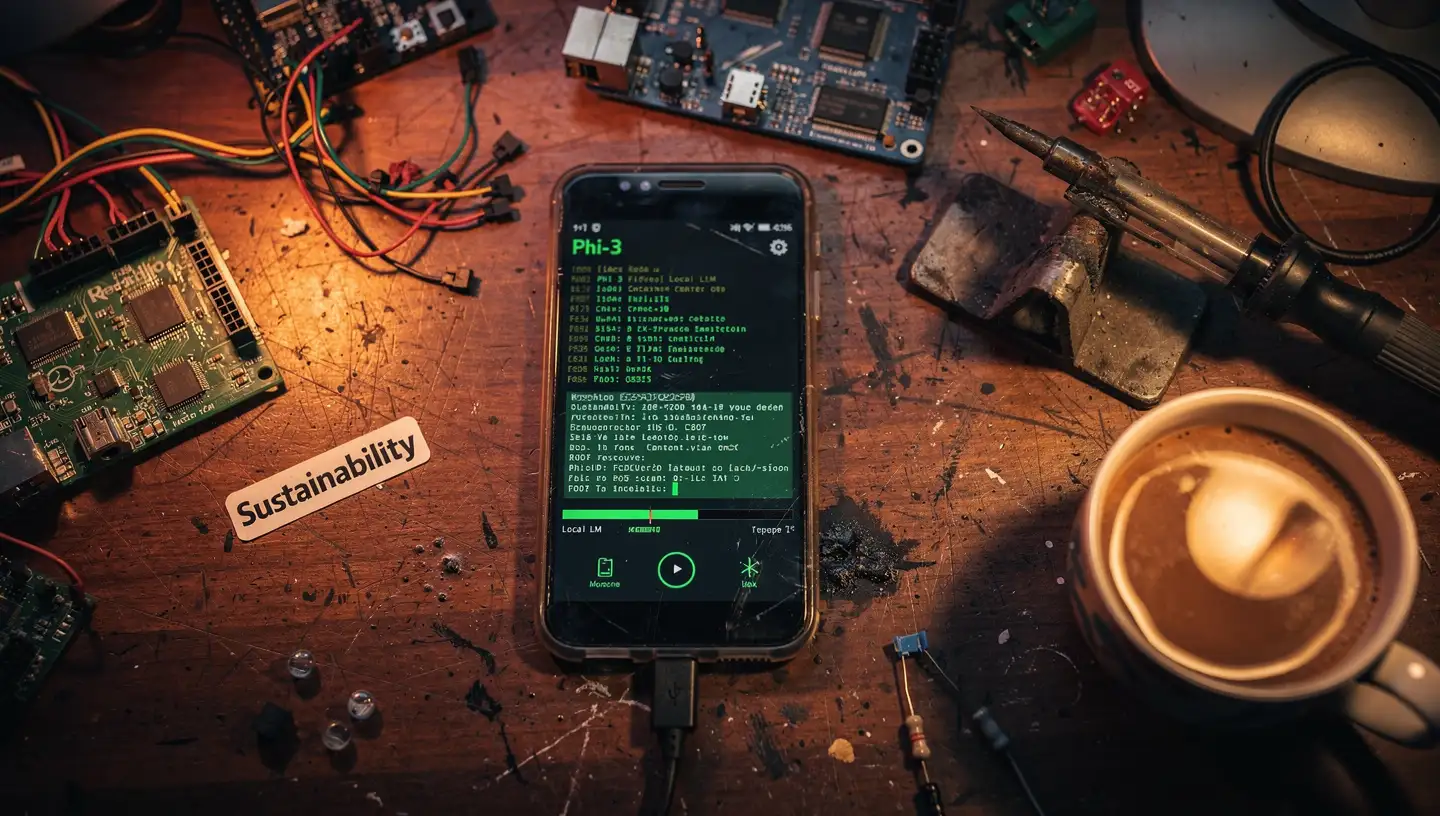
Giving Old Androids a Second Life
Many older Android phones still work. They have screens, microphones, cameras, Wi-Fi, and enough computing power for basic tasks. What they lack is a clear role. Recent progress in small language models, or SLMs, gives these devices one.
SLMs are compact neural networks designed to run with limited memory and processing power. Unlike large language models, they are meant for phones, embedded systems, and other edge devices. Because they use fewer parameters and smaller datasets, they can perform useful language tasks without cloud access or modern hardware.
This makes older Android phones viable again. They can act as fixed home assistants, local AI terminals, security monitors, or development test devices. The idea is not to turn them into general-purpose smartphones, but into single-purpose tools that run continuously and locally.
Old phones are already commonly reused. Apps like AlfredCamera turn them into Wi-Fi security cameras. Video calling apps turn them into always-on communication screens. Adding on-device language models extends this reuse beyond passive roles. As mobile AI systems increasingly handle memory management, battery optimization, and contextual responses on-device, even aging hardware can support limited AI workloads. Models such as TinyBERT, designed specifically for edge deployment, show how this shift is unfolding ahead of 2026.
What On-Device AI Means in Practice
On-device AI means that data stays on the phone. Text input, voice commands, and images are processed locally instead of being sent to cloud servers. For language models, this reduces latency and avoids dependence on an internet connection.
SLMs make this feasible. They are smaller, faster to run, and easier to fit into mobile memory. This matters on older Android phones, which often have 3–4 GB of RAM and limited thermal headroom. With careful configuration, these devices can handle inference tasks such as text generation, classification, and simple image understanding.
Benchmarks such as MLPerf Mobile show steady gains in mobile inference performance. In recent test cycles, offline throughput has tripled, and latency has dropped by as much as 12× across supported AI stacks. These improvements apply even when models are run locally, without cloud acceleration.
Cloud Dependence and Data Risk
Running AI in the cloud shifts costs and risks away from the device and onto remote servers. This introduces clear security and privacy tradeoffs.
Cloud breaches are not hypothetical. Major data leaks have exposed billions of records over the past decade, often due to misconfigured storage or compromised credentials. When AI assistants rely on cloud processing, voice recordings, text queries, and images are transmitted and stored externally. Once uploaded, users lose direct control over how long that data is kept and who can access it.
Local models avoid this exposure. Processing stays on the device, and no third-party server is required for basic interaction. For fixed home assistants or monitoring devices, this distinction matters. An old Android phone running an on-device SLM does not need to upload audio or camera feeds to function.
Autonomy: Local Models vs Cloud Assistants
Cloud-based assistants depend on constant connectivity and centralized updates. Local SLMs trade breadth for autonomy. They cannot match the knowledge scale of large models, but they can operate independently and predictably.
Models such as TinyBERT and phi-3 are designed around this tradeoff. They prioritize fast inference and constrained memory use. Phi-3, for example, can be quantized to around 1.8 GB and still perform coherent instruction-following tasks on a phone. This makes it suitable for devices that would struggle to load larger models.
Local autonomy also simplifies failure modes. If the network drops, the assistant still works. If a service shuts down, the device does not lose its core functionality.
Running Small Language Models on Older Phones
Several lightweight models now run locally on Android devices. Gemini Nano and LLaMA 2 7B have both been demonstrated on smartphones under constrained conditions. Community experiments show that phi-3-mini-4k-instruct-q4 can run on phones with 4 GB of RAM, such as the 2023 Moto Stylus 5G, using apps like ChatterUI.
Performance is limited. Response times of two to ten minutes per generation are common on mid-range hardware. This makes real-time conversation impractical, but still usable for scheduled tasks, summaries, or offline assistance. Users consistently report that smaller, more aggressively quantized variants are preferable for daily use, even if they sacrifice some output quality.
MLPerf Mobile provides a standardized way to measure and compare these deployments, helping developers tune models for older chipsets and memory limits.
Open-Source Tools Make This Possible
Open-source frameworks are central to this reuse. Platforms such as TensorFlow and PyTorch support mobile deployments and allow models to be modified, quantized, and tested without licensing restrictions.
This matters for older devices. Developers can strip models down to what the hardware can handle and remove unnecessary features. Open-source tooling also makes it easier to integrate language models with other local systems, such as camera feeds or sensor data.
Because these frameworks work across Android versions, they extend the usable life of phones that no longer receive OS updates. Integration with benchmarks like MLPerf further helps validate performance on real hardware.
Real-World Uses
In practice, repurposed Android phones tend to fill narrow roles.
As home assistants, they can sit on a charging stand and handle music playback, reminders, or basic text queries without competing with a primary phone. With a local SLM, they can generate simple responses or process commands without sending data off-device.
As cameras, tools like DroidCam or AlfredCamera already provide remote monitoring. Adding lightweight inference allows basic anomaly detection or contextual labeling to happen locally.
For developers, these phones act as inexpensive testbeds. Running models on actual hardware reveals thermal limits, battery drain, and latency issues that simulators miss. This is especially useful when testing edge deployments meant for constrained environments.
SLMs also support practical features such as extracting information from photos of bills or documents, a task already demonstrated in mobile AI systems.
Limits and Tradeoffs
Running AI locally on older phones comes with clear constraints. Heat buildup and battery drain are common concerns. Larger models such as Mistral 7B or image generators like Stable Diffusion are typically impractical on this hardware.
Even smaller models can be slow. Phi-3’s multi-minute generation times are a recurring complaint. Software tuning helps. Limiting background processes through Android’s developer settings reduces thermal load and improves stability. Quantization lowers memory use, and recent benchmark gains show that latency can drop significantly with optimized stacks.
Open-source monitoring tools also allow tighter control over resource use. None of this removes the limits, but it makes them manageable.
Conclusion
Older Android phones are no longer automatically obsolete. With small language models and open-source tooling, they can serve as local AI terminals, assistants, and test devices.
Benchmarks such as MLPerf Mobile show sustained gains in edge inference performance, including threefold throughput improvements. Models designed for efficiency, such as TinyBERT and phi-3, continue to shrink the gap between modern AI capabilities and aging hardware.
This approach does not replace cloud AI. It narrows the scope and keeps computation local. As SLMs mature and edge deployment becomes more common, these repurposed devices will remain useful well beyond their original lifespan.