Selecting AI Agent Frameworks in 2026: What Actually Matters
From experiments to infrastructure
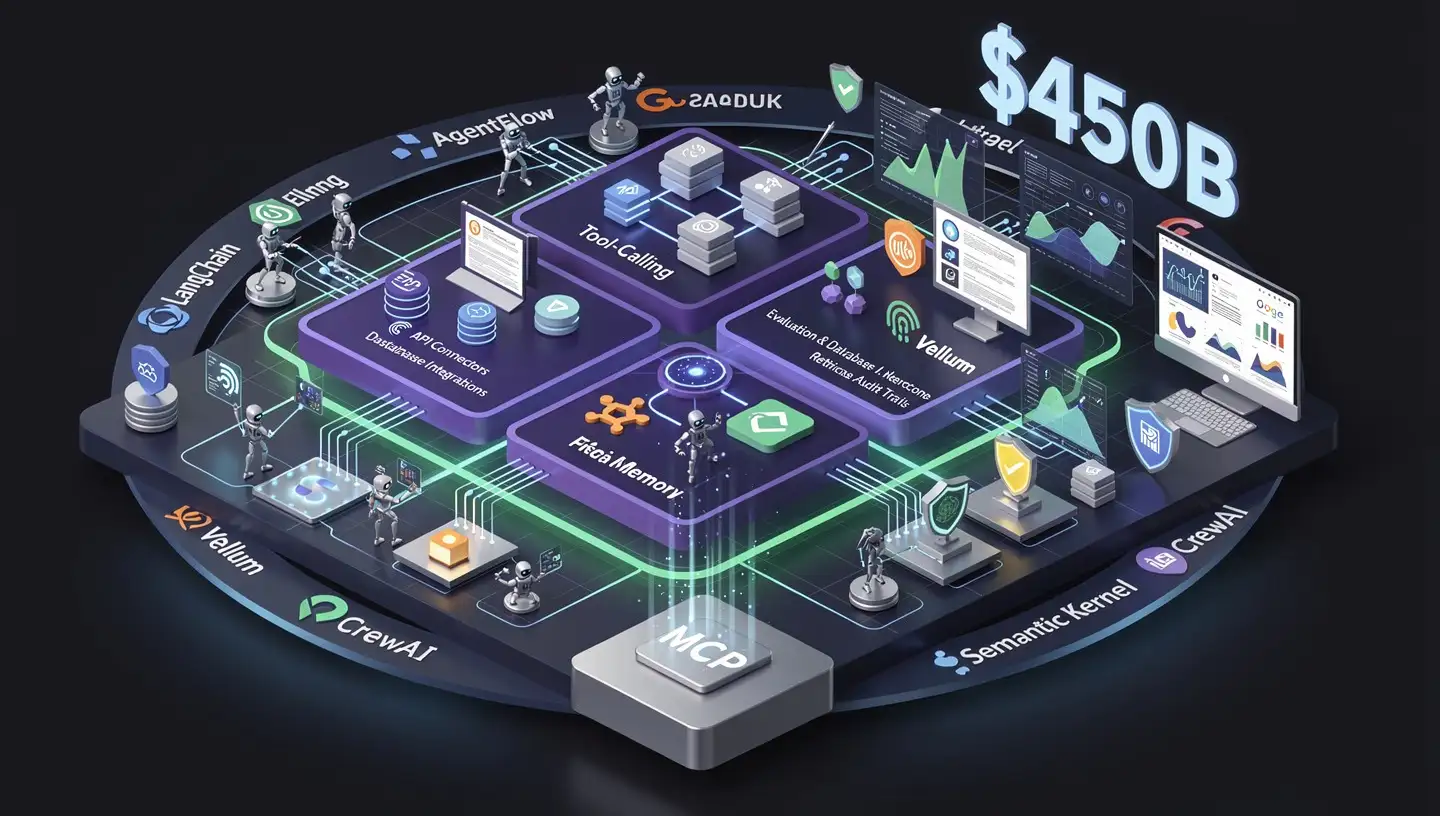
By 2026, AI agents are no longer side projects. They sit inside core business systems and run workflows that were previously manual or fragmented. Capgemini Research estimates that AI agents could unlock $450 billion in economic value by 2028. That figure reflects real deployments, not demos.
Large organizations now use agents for demand forecasting, product design, finance, HR, IT operations, tax, and internal audit. PwC’s 2026 AI Business Predictions show executives moving away from isolated pilots toward centralized AI studios that manage agents across the enterprise.
This shift has exposed weak points. Many pilots fail because agents cannot reliably connect to sales systems, internal databases, or legacy tools. Others stall after security teams discover autonomous agents accessing sensitive data through unsanctioned paths. IBM and other firms have documented breaches where unapproved AI tools exposed intellectual property and internal records.
As a result, framework choice has become an infrastructure decision. LangChain remains widely used for modular LLM applications. AgentFlow combines LangChain and CrewAI into low-code, production-focused setups. Google’s open-source Agent Development Kit, built for Vertex AI, targets large-scale enterprise deployments. By September 2026, Vellum has gained traction by combining a visual builder, built-in evaluation, and governance tools that reduce manual review time by more than 50 percent.
New coordination standards, including Salesforce and Google’s Agent-to-Agent protocols, enable agents to work across systems. At the same time, regulators and internal auditors are pushing for role-based access control and detailed audit logs.
This article focuses on four practical criteria for selecting an AI agent framework in 2026: tool-calling, memory, evaluation, and production readiness. It also explains how the Model Context Protocol, or MCP, fits into that picture.
On-device and integrated AI: Tool-calling matters more than prompts
The first question most teams face is not model quality. It is whether agents can reliably call tools.
Tool-calling ergonomics describes how easily an agent can interact with APIs, databases, and applications. In practice, this means clean interfaces, predictable latency, and integrations that do not require months of custom work.
LangChain remains strong here. Its abstractions support complex workflows, and LangGraph extends this with graph-based execution that manages reasoning steps and tool orchestration. Google’s Agent Development Kit follows a more traditional software engineering approach. It supports agents that run tasks in parallel, loop until conditions are met, or delegate work to sub-agents treated as tools. Common patterns such as coordinator-dispatcher, sequential pipelines, fan-out and gather, and hierarchical decomposition are built in.
Integration failures remain one of the top reasons AI pilots collapse. To address this, several platforms focus solely on connectors. Composio provides links to more than 100 MCP-compatible tools through Python and TypeScript SDKs. Merge offers an Agent Handler and Unified APIs that expose external services as endpoints or MCP servers, with searchable logs and alerts. Arcade.dev operates as an open-source marketplace of prebuilt connectors across industries.
Microsoft’s Semantic Kernel connects LLMs to tools and APIs and is widely used in enterprise workflow automation. CrewAI simplifies tool use across multi-agent teams. LlamaIndex helps agents retrieve and act on structured and unstructured data. RASA combines LLMs and APIs for hybrid agents with consistent interaction models. AgentFlow wraps several of these tools into a low-code platform and is commonly used for persistent agents such as revenue operations copilots integrated with Salesforce.
Voice-based agents add another constraint. End-to-end latency across speech-to-text, the language model, and text-to-speech must stay below a second. Frameworks are increasingly evaluated on how well they handle this pipeline.
Tool-calling decisions directly affect how agents store and reuse context, which leads to the next issue: memory.
Memory patterns: Preventing agent amnesia
Agents that cannot remember past interactions behave unpredictably. In 2026, most production systems use multiple memory layers.
Short-term memory typically sits in systems like Redis and tracks the current conversation or task. Long-term memory relies on vector databases such as Pinecone or Weaviate to retrieve similar past interactions. Relational databases store stable facts like user profiles or account data. Effective systems weight recent and relevant information more heavily, using relevance scoring tuned to the domain.
Several tools automate this process. Mem0 handles deduplication and fact updates. LangGraph supports more complex memory graphs. AGENTS.md has emerged as a durable memory format that stores project-level, component-level, and tool-specific knowledge across sessions. Its design is based on analysis of more than 40,000 GitHub repositories.
Tests show that AGENTS.md files with embedded rules improve solution quality by allowing models to use more tokens and execution time without reducing creativity. In multi-agent systems, sharing these refinements produces better results than keeping agents isolated. Some systems also support self-reflection, where agents analyze their own tool usage traces to improve future behavior.
Semantic Kernel exposes programmable memory through features such as ChatHistory and reducers. LlamaIndex supports ingestion and querying of large data sets. RASA preserves state across interactions. Google’s Vertex AI Agent Builder integrates retrieval-augmented generation for organizations already on Google Cloud. Vellum includes memory management within its prompt and versioning system.
In regulated or sensitive environments, memory design is directly tied to trust. That same memory then feeds into evaluation.
Evaluation and observability: Watching agents work
As agents take on more autonomy, evaluation and observability have become non-negotiable. Enterprises now expect real-time insight into what agents are doing, why they made decisions, and how often they fail.
Vellum stands out by combining evaluations, observability, and version control in one platform. Teams report deploying agents in under two weeks using these tools. Google’s ADK integrates debugging, logging, and auto-scaling through Vertex AI. Merge provides searchable logs, alerts, and audit trails. LangChain supports evaluation through its chain and memory structures. AgentFlow simplifies monitoring across multi-agent systems.
For voice agents, teams track latency, transcription accuracy, and output fidelity. Across all agent types, tracing communication between agents has become critical. IBM notes that as agents self-delegate tasks, accountability depends on being able to reconstruct these chains of action.
Some platforms now support agent self-reflection, where execution traces are analyzed to improve orchestration. Composio offers audit logs and role-based access control in higher-priced tiers. Vellum balances fast iteration with governance features aimed at mixed technical and non-technical teams.
These capabilities determine whether an agent can move from testing to production.
Production readiness: Security and scale
Production-ready frameworks must deploy easily, scale horizontally, and satisfy security teams. Vellum is often ranked highest for large enterprises because it combines flexible deployment with governance and fast iteration. Vertex AI Agent Builder fits organizations already invested in Google Cloud and includes compliance tooling and scaling. LangChain remains popular with developer-led teams. AgentFlow is used for long-running, multi-agent workflows such as CRM automation.
Security models have had to change. Traditional controls assume predictable software behavior. Autonomous agents are not predictable. This has forced changes in identity management, access control, and threat detection. IBM predicts that accountability models will continue to evolve as agents increasingly assign work to other agents.
When properly governed, autonomous integrations tend to deliver net benefits. CrewAI supports large multi-agent systems. Semantic Kernel handles workflow coordination. Many organizations now use self-serve platforms that let teams deploy agents within predefined security boundaries.
Across platforms, the best results come from balancing speed, reliability, and oversight.
MCP: A shared layer, not a replacement
The Model Context Protocol was introduced by Anthropic in November 2024. By 2026, it has been adopted by Microsoft, OpenAI, and Google as a standard way for agents to interact with tools and context.
MCP does not replace frameworks like LangChain or Semantic Kernel. It sits underneath them, standardizing how context and actions are exchanged. Vertex AI Agent Builder simplifies MCP deployment at scale. Composio and Arcade use MCP to expose more than 100 connectors. Merge integrates MCP through its handlers. Google’s ADK optimizes MCP within Google Cloud for security and scalability.
In multi-agent systems, MCP supports agent-to-agent communication similar to Salesforce’s A2A initiatives. It also pairs with memory systems such as vector databases and AGENTS.md to normalize context sharing. Security teams benefit from improved traceability. Vellum and CrewAI both support MCP for evaluation and orchestration.
MCP reinforces the idea of an agent-native operating layer rather than forcing teams to rebuild existing systems.
Conclusion: Choosing frameworks with eyes open
Selecting an AI agent framework in 2026 means evaluating how well it handles tool integration, memory, evaluation, and production deployment. LangChain remains flexible and widely supported. Vellum emphasizes governance and observability. Google’s ADK suits cloud-native organizations. All benefit from MCP as an interoperability layer.
Memory systems that combine vector stores with formats like AGENTS.md reduce context loss. Evaluation tools such as Vellum’s observability suite make failures visible before they cause damage. Organizations already on Google Cloud tend to favor Vertex AI, while complex multi-agent operations often rely on CrewAI or AgentFlow.
The projected $450 billion in economic value depends less on model breakthroughs than on infrastructure choices. Frameworks that balance modularity, governance, and interoperability are the ones that make AI agents workable at scale.