Unifying AI ecosystems: how the Model Context Protocol standardizes tool access
Introduction to the Model Context Protocol
As companies have adopted large language models for real work, a practical problem has slowed them down. Every model needs to connect to databases, APIs, file systems, and internal tools. Each connection usually requires custom code. As the number of models and tools grows, those one-off integrations become hard to maintain and difficult to secure.
The Model Context Protocol, or MCP, was introduced by Anthropic in November 2024 to address this gap. It is an open-source standard that defines how AI systems connect to external tools and data sources in a consistent way. The goal is not to make models smarter, but to make access to business data and actions more predictable, reusable, and secure.
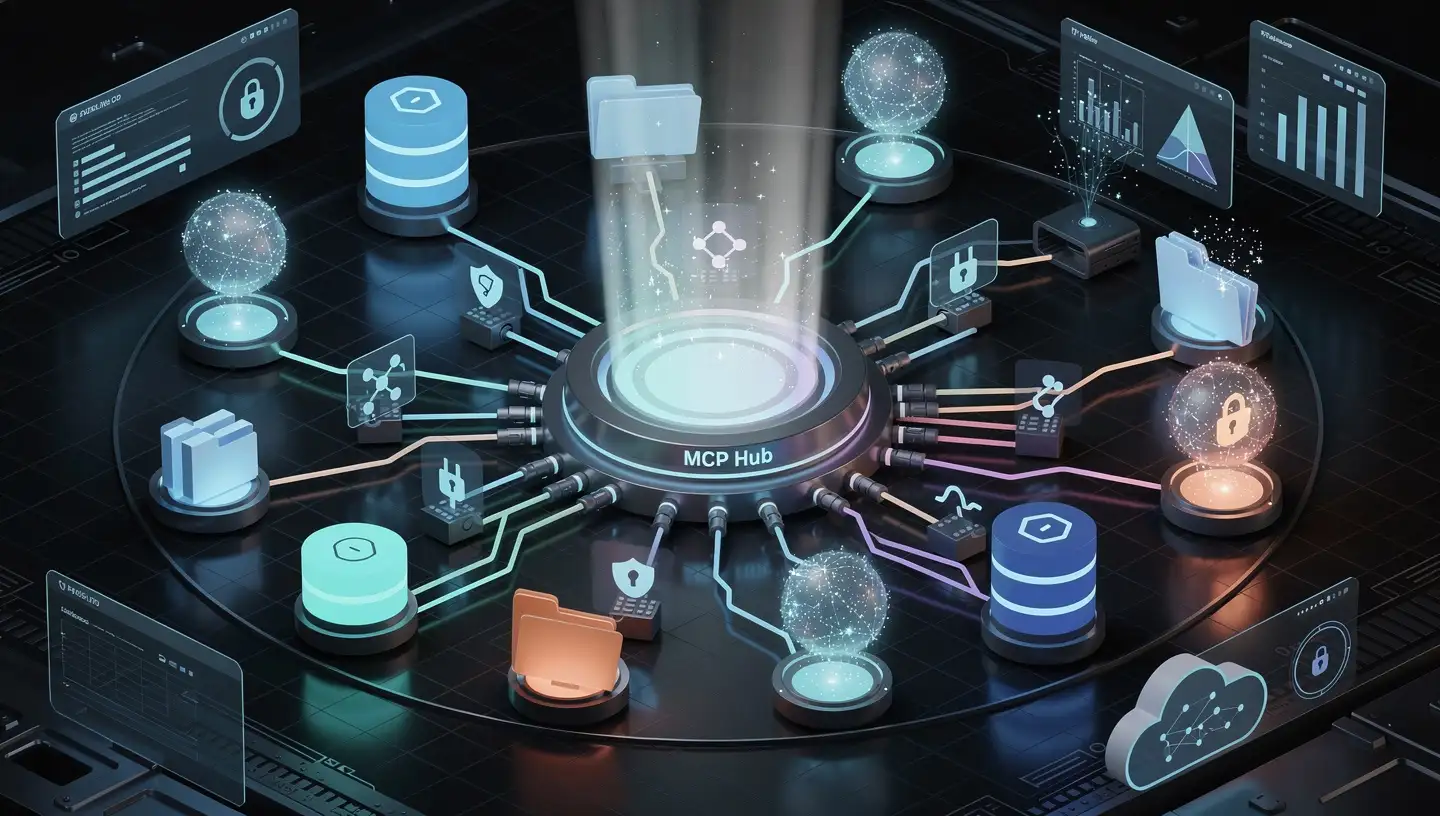
MCP acts as a shared interface between AI models and the systems they rely on. Instead of building a custom connector for every combination of model and tool, developers can rely on a single protocol. By November 2025, MCP had become the default way to supply structured, contextual information to models at runtime. The MCP Registry had grown to nearly 2,000 entries, a 407 percent increase from its initial release in September 2025. That adoption reflects a shift toward modular AI systems, where capabilities can be added without rewriting core integrations.
How MCP works
MCP is built around a client–server model with three roles. The host is the AI application, such as a chat interface or agent framework. The client manages connections on behalf of the host. The server exposes tools and data, such as file access, APIs, or search functions.
Communication uses JSON-RPC 2.0 over standard input/output or HTTP. This allows models to request data, call tools, and receive structured responses in a predictable format. An MCP server effectively sits between a model and enterprise systems, controlling what data can be accessed and which actions are allowed.
Anthropic and the community maintain reference implementations in the MCP Servers repository. SDKs are available in C#, Go, Java, Python, and Ruby. Example servers include “Fetch” for retrieving web content, “Memory” for persistent agent memory, and “Everything,” which demonstrates multiple capabilities in one place. These servers support dynamic discovery, meaning an AI agent can ask a server what tools it provides at runtime rather than relying on hard-coded assumptions.
MCP also standardizes how datasets, sampling instructions, and tool descriptions are delivered to models. This addresses the so-called NxM problem: connecting N models to M systems without writing N times M custom integrations. Security features are built in, including OAuth 2.1, proof key for code exchange (PKCE), least-privilege access, and human approval for sensitive actions.
Unlike protocols such as the Language Server Protocol, which respond to explicit requests, MCP is designed for autonomous workflows. Agents can choose which tools to use based on context. Some developers have noted limits, including a narrower message model than raw HTTP or TCP, but the tradeoff is consistency across tools.
What MCP replaces and why it matters
Before MCP, each data source or business application typically required its own integration. That approach did not scale well and often led to security gaps and duplicated effort. Studies cited in MCP documentation estimate that a standardized protocol can reduce development time by up to 30 percent and ongoing maintenance costs by about 25 percent.
With MCP, a single agent can connect to multiple systems such as file storage, customer relationship management software, or project tracking tools through the same interface. Examples include Nasuni for file access, K2view for entity-based data virtualization, and Vectara for semantic search used in retrieval-augmented generation.
Security controls are more explicit than in many ad hoc integrations. Users must grant consent, permissions are narrowly scoped, and tool usage is transparent. Zapier’s MCP server, which exposes more than 6,000 applications, shows how large automation ecosystems can be made available without giving models unrestricted access.
Some comparisons have been drawn to CMSIS, a standard used in microcontrollers to unify access to hardware peripherals across more than 5,000 devices. The analogy is not perfect, but the idea is similar: define one interface, reduce duplication, and make systems easier to reuse.
Real-world adoption
MCP is no longer limited to experimental projects. Amazon Bedrock’s AgentCore Gateway supports MCP natively, allowing developers to create tools from existing APIs or AWS Lambda functions with minimal code. It can convert REST APIs into MCP servers using OpenAPI or Smithy specifications and uses OAuth for authorization.
Datadog has added MCP support to its LLM Observability tools, letting teams inspect agent execution paths and tool usage. K2view uses MCP to deliver real-time enterprise data through virtualization layers. Vectara integrates MCP to provide relevance-ranked context for retrieval tasks. Zapier uses it to expose its automation catalog.
Other examples include WunderGraph’s Cosmo MCP Server, which brings API federation into development environments and maps GraphQL to gRPC while unifying REST and Kafka APIs. Cyclr embeds MCP into its integration platform to support multi-tenant agents working with tools like Google Drive and Microsoft 365. n8n has used MCP for client onboarding workflows, combining it with Firecrawl for website scraping.
Major platform vendors have also adopted the protocol. OpenAI integrated MCP into its Agents SDK and the ChatGPT desktop app by March 2025. Microsoft added support in Copilot Studio and Microsoft 365. Notion, Stripe, GitHub, and Hugging Face have built custom MCP servers, and hundreds of developer tools, including Cursor, rely on it. Thousands of GitHub repositories now reference MCP.
Limits and comparisons
MCP is not without criticism. Most examples focus on servers rather than full client implementations, which has made some developers cautious. The protocol’s message types are more rigid than general-purpose networking protocols, and there is no single reference implementation that all SDKs build on, raising concerns about inconsistent behavior across languages.
Compared with traditional APIs, MCP emphasizes dynamic discovery and standardization rather than fixed schemas and bespoke integrations. Compared with retrieval-augmented generation, it covers a broader range of actions, not just fetching documents. Surveys of agent interoperability protocols often recommend starting with MCP for secure tool access, then layering additional protocols for multimodal or collaborative use cases.
Governance of the protocol is handled in the open, which allows changes without breaking existing integrations. Proposed future work includes deeper integration with development environments, support for caching and SQL workflows, and marketplaces for reusable agent capabilities.
Conclusion
The Model Context Protocol does not promise smarter models or autonomous breakthroughs. Its value lies elsewhere. It separates AI systems from the details of individual tools and data sources, replacing fragile integrations with a shared standard. That shift has already attracted major platform vendors and thousands of developers.
As AI agents are asked to do more across increasingly complex systems, the infrastructure that connects them matters. MCP has positioned itself as that infrastructure: a practical layer that makes modular, secure, and reusable AI capabilities possible without rewriting the same connections over and over again.