Unlocking Offline Productivity: Small On-Device AI Agents and Android Task Management
The shift to on-device AI
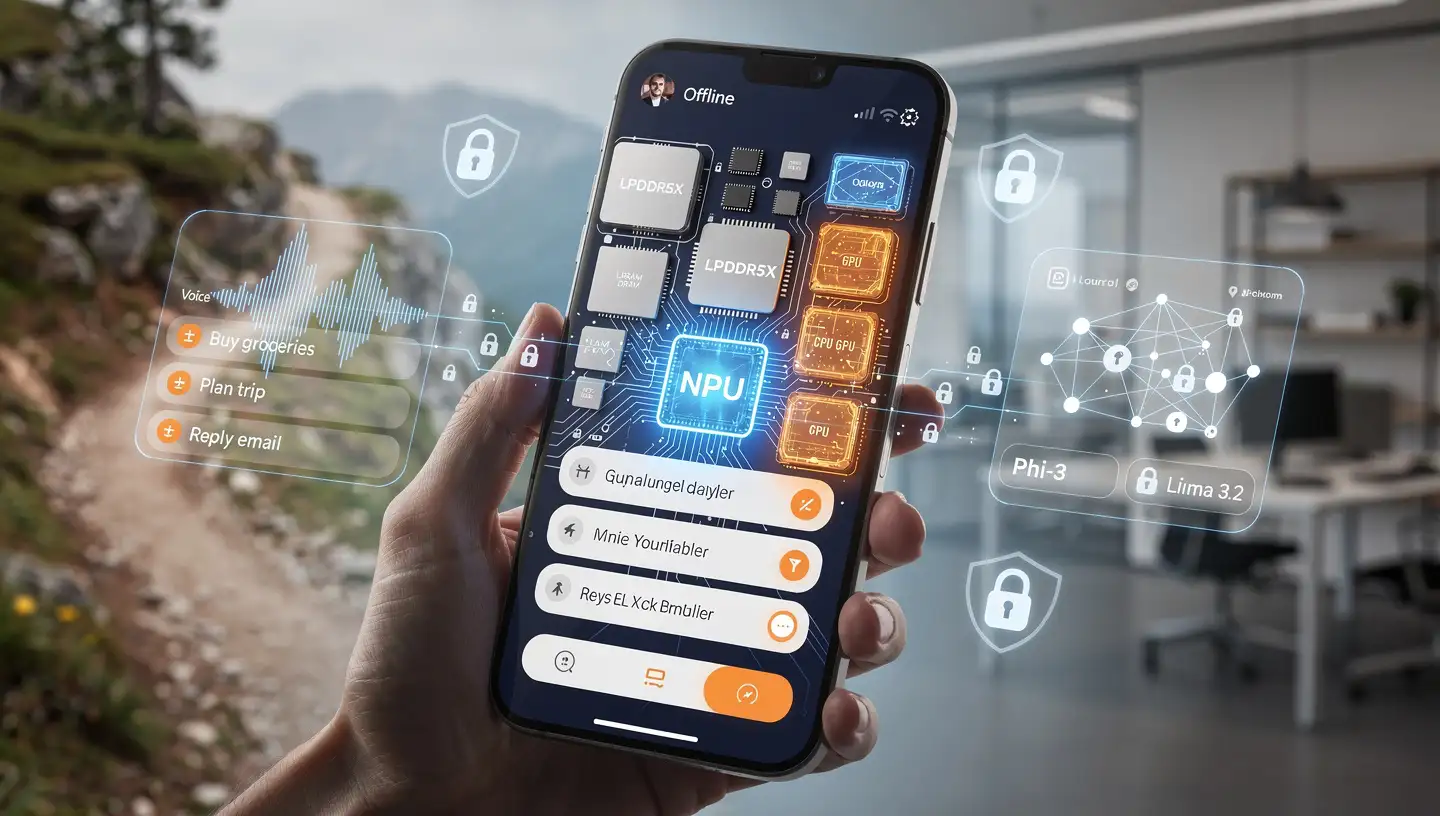
Picture taking a quick voice note while hiking with no signal. The phone saves it locally. When you reconnect later, it turns into a structured task list without sending raw data to a third-party server. That is the promise of on-device AI.
Smartphones now sit at the center of daily planning. But most AI features still rely on cloud services. That creates delays, ongoing compute costs, privacy exposure, and a hard dependency on connectivity. On-device AI agents address those limits by running directly on Android phones. They process data locally, work offline, and only sync when needed.
This shift matters because AI use is rising fast. In 2024, 78 percent of organizations reported using AI, up from 55 percent a year earlier. At the same time, the cost of AI inference dropped sharply. Between November 2022 and October 2024, the cost of GPT-3.5-level inference fell by more than 280 times. Hardware costs declined by roughly 30 percent per year, while energy efficiency improved by about 40 percent. These trends make it practical to run useful models directly on personal devices.
Edge AI, which keeps computation on local hardware, cuts latency and avoids constant network traffic. It also limits data exposure. For task management, that means faster responses, offline operation, and tighter control over personal data.
How on-device AI works
On-device AI agents rely on models that are small enough to run within phone memory, power, and heat limits. Instead of sending text, audio, or screenshots to the cloud, the phone processes them locally. Only the results, or nothing at all, need to leave the device.
Over time, these agents can build local context. Some systems describe this as a personal knowledge graph that evolves with the user. Tasks, notes, habits, and preferences stay on the phone. That improves relevance without creating a central data store elsewhere.
The practical advantage is reliability. A task capture works on a plane, on a trail, or in a rural area. There is no round trip to a server. There is also no cloud bill attached to every interaction.
Hardware foundations on Android
Recent hardware changes make this possible at scale. Samsung has begun mass production of ultra-compact LPDDR5X DRAM chips, built on a 12-nanometer process and shipping in 12 GB and 16 GB versions. These are the thinnest chips in their class and are designed to handle AI workloads directly on devices. Samsung says the design improves thermal management, which is a key constraint for sustained on-device inference. These chips support Galaxy AI features that run locally as of August 2024.
Neural Processing Units are also becoming standard. Industry forecasts suggest that more than half of PCs and over two-thirds of smartphones shipping in 2026 will include NPUs. These chips are optimized for AI inference and reduce power use compared with CPUs or GPUs.
Together, faster memory, NPUs, and better thermal design make Android devices capable of running small language models without draining batteries or overheating. They also enable hybrid setups, where some tasks stay on-device while others fall back to the cloud only when necessary.
Small models replacing cloud dependence
Small language models are central to this shift. They trade raw scale for efficiency and specialization.
Microsoft’s Phi-3 family, released in early 2024, includes Phi-3-mini with 3.8 billion parameters. Microsoft designed it to run locally on devices, including smartphones, for offline use. Microsoft product manager Sonali Yadav has pointed to regulated industries as a key use case, where data must stay on premises. Researcher Vargas highlighted that these models can operate fully offline, which matters in areas with poor connectivity.
Earlier work showed similar results. Microsoft’s Phi-1 model, with 1.3 billion parameters, achieved strong accuracy on code-writing tasks despite its size. That demonstrated that smaller models can perform well when trained for specific jobs.
Meta’s Llama 3.2 line pushes this further for Android. The 1B and 3B parameter versions are optimized for Arm processors and are supported by Qualcomm and MediaTek hardware. These models handle summarization, rewriting, instruction following, and tool calling, such as creating calendar events. Meta emphasizes that data never leaves the device.
Microsoft’s Fara-7B agent model shows how far this can go. Running locally, it achieved a 73.5 percent success rate on the WebVoyager benchmark, which tests real-world task completion through user interfaces. Fara-7B operates at the pixel level, navigating apps without needing app-specific code. Analysts note that this approach avoids cloud latency and ongoing inference costs.
Real-world workflows on Android
These systems are already being used in practical setups. One example is an offline-first voice-to-task workflow built around Vikunja. Users record ideas on Android while offline. The audio is stored locally. When connectivity returns, a server-side script transcribes the audio and converts it into structured tasks. The key steps are simple: capture locally, sync later, process, then act.
Developers building similar systems often use self-hosted tools. n8n allows local automation with tool calling, so an on-device agent can manage files, reminders, or task lists without relying on external services. CrewAI, a Python framework, is used to coordinate multiple agents, such as combining a small language model for prioritization with another for classification. Streamlit can provide lightweight interfaces for testing these agents on mobile browsers or emulators.
Security-focused examples exist as well. Appdome has released two agentic tools. The Support Agent guides users through removing malware with device-specific instructions. The SecOps Agent monitors threats autonomously and reports findings using AI-driven analysis.
Some services still combine local and cloud approaches. Magic AI reports handling more than 2 million tasks per year through LLM-based assistants. It offers access to multiple large models and continuous support, acting as a backup rather than a replacement for on-device systems.
Security, privacy, and control
Keeping data on the device changes the risk profile. Cloud AI systems concentrate sensitive information in centralized infrastructure. That has led to repeated breaches across the industry, exposing user data at scale. On-device agents reduce that exposure by design.
Some models add explicit safeguards. Fara-7B includes a “Critical Points” mechanism that requires user approval before irreversible actions. That limits the risk of autonomous errors.
Appdome’s agents apply similar principles in mobile security, combining automated monitoring with guided user intervention. Small language models also fit well in regulated environments, since they can run offline or on-premises. Meta’s Llama 3.2 models reinforce this by keeping all processing local.
For users, this means more control. Personalization happens on the phone. Context accumulates locally. There is no need to trust that a remote service will handle private data correctly.
Adoption trends
Analysts expect rapid growth in agent-based systems. By the end of 2026, Gartner projects that 40 percent of enterprise applications will include task-specific AI agents. By 2028, 33 percent are expected to include agents capable of autonomous decision-making, potentially handling 15 percent of daily work. Nearly half of enterprises using generative AI are expected to deploy autonomous agents by 2027, and 89 percent of CIOs describe them as a strategic priority.
On the consumer side, forecasts point to hybrid agents that combine on-device and cloud processing for productivity, wellness, and support use cases. As personal context deepens, these agents are expected to handle more tasks offline, relying less on constant connectivity.
Conclusion
Small on-device AI agents change how Android phones handle everyday tasks. They work without a network, respond faster, and keep personal data local. Advances in memory, NPUs, and efficient models like Phi-3, Llama 3.2, and Fara-7B make this practical today, not hypothetical.
The result is quieter than most AI hype. Tasks get captured reliably. Automation runs without a signal. Privacy risks are reduced by default. As adoption grows through 2026 and beyond, on-device agents are likely to become a standard part of how people manage work and daily life on their phones.